A Meal with One Thing to Notice
A meal with one thing to notice offers a gentle way to practise attention: choose a detail that fits your appetite, setting and company.
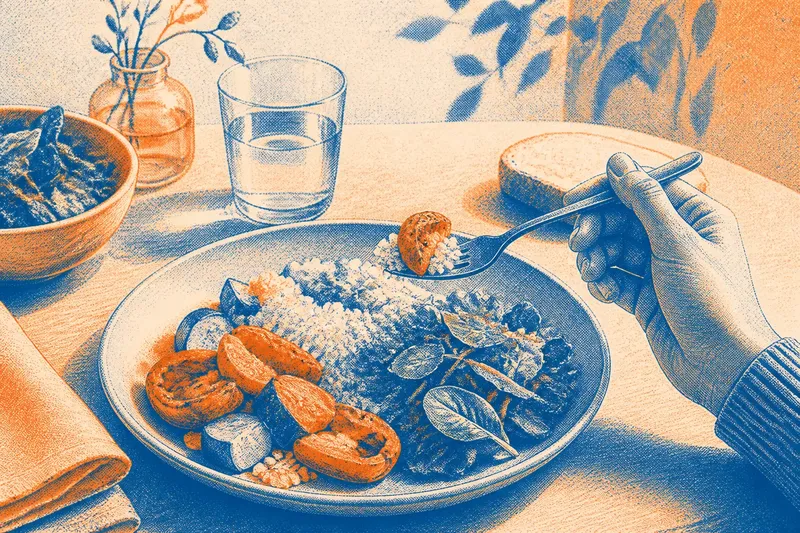
The common mistake with a meal with one thing to notice is trying to pay attention to everything. That can make an ordinary lunch feel like an assignment, drawing attention away from the food and the people around you. A gentler approach is to choose one detail, stay with it briefly, and let the meal continue as usual.
The detail might be how a familiar food is arranged, how its texture changes as you chew, or the order in which you move through a plate. These are options, not stages to complete. You can stop noticing whenever it feels forced, and there is no special result to reach.
Choose a detail that suits the meal
Different kinds of attention fit different situations. The arrangement of food is easy to notice before eating; texture becomes apparent during a bite; sequence draws attention to the way you move through the meal. Choose the one that asks least of you in that moment.
- Arrangement: Notice where foods sit on the plate, or how a bowl of soup looks beside a piece of bread. This suits a meal where you can pause before the first bite without delaying anyone.
- Texture: Attend to a single bite: perhaps the contrast between crisp cucumber and soft rice, or the smoothness of yoghurt. This suits an everyday meal when you are already seated and can notice without changing how you eat.
- Sequence: Notice what you reach for first, or how you alternate between two foods. This suits a familiar meal where the order is already easy to observe.
Say you have a sandwich and an apple at your desk. You might choose texture and notice the crisp edge of the apple during one bite, then return to your usual lunch. The expected observable result is simply that this one quality has received attention; the meal need not become slower or more elaborate.
Arrangement suits a brief pause before eating
Looking at the arrangement works well when there is a natural moment before the meal begins. You could notice the colour of a roasted pepper beside a pale slice of bread, the way a spoon rests near a bowl, or how a shared serving dish is positioned on the table. Nothing needs to be rearranged for the sake of the practice.
This option can feel comfortable when you prefer not to focus closely on each bite. It also fits a meal with other people: a quiet glance at your plate does not require anyone to join in or wait. If the food is served casually or the meal is already under way, skip the pause rather than trying to create one.
Let the first ordinary action set the pace: pick up your fork, pass the bread, or take a sip.
Texture suits attention during a bite
Texture offers a concrete detail without asking you to analyse the whole meal. You might notice a crust breaking, a soft filling, or the difference between a warm drink and a cool spoonful of fruit. A brief observation is enough; there is no need to describe every sensation or judge whether it is pleasant.
This approach may suit a familiar meal when a short pause feels welcome and you can eat comfortably. It may be less suitable if close attention to food feels distracting, uncomfortable, or entangled with difficult feelings about eating. In that case, choose the arrangement instead, or leave the practice aside.
Keep eating in a way that feels ordinary to you; attention is not a reason to restrict, delay, or alter a meal.
Sequence suits a familiar routine
With sequence, the detail is not a sensation but the pattern of your choices. Perhaps you take a bite of pasta, then a piece of salad; perhaps you begin with the soup before reaching for bread. Notice the pattern without deciding that one order is better than another.
This option often suits meals whose structure is already familiar, because there is something simple to observe. It may be less useful at a buffet, during a shared meal with frequent conversation, or whenever your attention is needed elsewhere. You can also notice only the opening of the meal and then let the pattern go.
How do you choose a detail without making it a task?
How long should I pay attention?
There is no required duration. Notice one detail for a moment, a bite, or the natural pause before eating, then carry on when attention moves elsewhere.
Can I do this while eating with other people?
Yes, if it remains unobtrusive and comfortable. You can notice the food quietly while listening and speaking as usual; conversation does not need to stop.
What if my attention keeps wandering?
That is ordinary, not a failed attempt. If you want, return once to the detail you chose; otherwise, let the meal continue without correcting yourself.
Should I choose the same detail each time?
You can repeat one approach if it feels easy, or choose a different detail to fit the meal. There is no need to track choices or make them consistent.
Choose by comfort, not by a rule
A simple way to choose is to ask what is already easiest to notice. Before eating, look at the arrangement; during a comfortable bite, notice texture; with a familiar routine, observe sequence. If none feels natural, the meal does not need a mindfulness detail.
Try one option without treating it as a promise to continue. If it makes the meal feel more attentive in a comfortable way, you can use it again; if it adds pressure, leave it out. A meal with one thing to notice works best as a small invitation, not another standard to meet.
When the meal ends, let the plate, conversation, and next part of the day take your attention. The useful part may be no more than having noticed one ordinary detail along the way.